




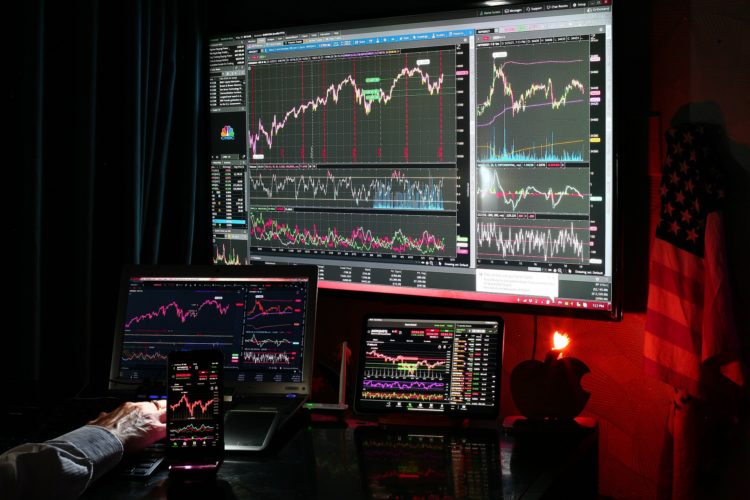
Thursday, November 5, 2026, was the worst day for U.S. equity markets in months. The S&P 500 fell 4.36% to 7,354, its worst single-day drop since April 2025. The Nasdaq Composite dropped 5.52% to 24,315, entering correction territory, and the Dow Jones Industrial Average lost 3.4%, or 1,833 points, to close at 51,523. The selloff was broad, violent, and concentrated in the technology and semiconductor names that had powered the market's gains.
What happened on November 5
The day's losses erased an enormous amount of value. The seven biggest technology companies shed roughly $1.1 trillion in combined market value in a single session. The Nasdaq lost more than $2 trillion in market capitalization during the day, according to Reuters and Wall Street Journal reporting. The Philadelphia Semiconductor Index fell 12.25%, its second-biggest decline on record, as chip stocks collapsed across the board.
Individual moves were extreme even by the standards of a volatile market. SanDisk fell 22.26%, Micron Technology dropped 17.46%, and Advanced Micro Devices slid 17.26%. Nvidia, the company most closely associated with the artificial intelligence boom, fell 9.26%. The scale of the declines in companies at the center of the AI buildout underscored that this was not a routine pullback but a reassessment of a central market thesis.
Fear gauges reflected the panic. The Cboe Volatility Index, known as the VIX, closed at 28.18, up 11.57 points on the day — a sharp spike that signals investors were rushing to buy protection against further declines.
Why investors reassessed the AI data-center buildout
The trigger for the selloff was a reassessment of the economics of the AI data-center buildout. For much of 2025 and 2026, investors had rewarded companies pouring tens of billions of dollars into data centers, chips, and power infrastructure, on the assumption that AI demand would justify the spending. On November 5, that confidence cracked, and the same spending began to look like a source of risk rather than a guarantee of growth.
The political backdrop added to the uncertainty. Democrats scored sweeping wins in the midterm elections, a result that raised questions about the policy environment for large technology companies and for the pace and regulation of AI infrastructure investment. Markets often react sharply when a political outcome changes the assumed rules of the game, and November 5 combined a political shift with an already fragile valuation story.
What is a market correction?
The Nasdaq's decline placed it in correction territory, meaning it had fallen roughly 10% or more from its recent peak. The index is now about 11.9% below its record set on October 6. A correction is a defined market term, not a crash: it describes a decline of 10% to 20% from a peak. Corrections are a normal feature of equity markets and have historically occurred frequently, but they can feel dramatic when they arrive in a single day rather than over weeks.
For context, the S&P 500's 4.36% drop was its worst day since April 2025, a reminder that large single-day declines are rare but not unprecedented. Markets had climbed to record territory in October, which made the fall from a high level particularly large in dollar terms.
The Bank of England raised rates
The selloff was not only an American story. The Bank of England raised interest rates to 4% from 3.75%, its first rate hike since 2023. Higher rates in a major economy matter for global investors because they raise borrowing costs, lift the discount rate applied to future earnings, and tend to pressure the valuations of growth stocks whose profits are expected years in the future. The move added to the sense that financial conditions were tightening at the same time equity valuations were being questioned.
Oil prices rose
Energy markets moved in the opposite direction. West Texas Intermediate crude oil settled at $90.52 a barrel, up 2.7% on the day. Rising oil prices alongside falling stocks is a combination that often worries investors, because higher energy costs can squeeze corporate margins and household budgets at the same time that asset prices are falling.
Why it matters for founders and investors
For founders, a day like November 5 is a signal about the funding climate. When public-market valuations of technology companies fall sharply, private-market investors typically become more cautious, fundraising timelines lengthen, and the valuations attached to growth-stage rounds come under pressure. Companies whose stories depend on AI infrastructure spending face particular scrutiny: investors now want evidence that data-center investment generates returns, not just scale.
For investors, the rout is a reminder that concentration is risk. A market led by a handful of giant technology stocks can fall fast when the shared thesis behind those stocks is questioned. Diversification, cash reserves, and attention to the fundamentals of individual companies matter more in a correction than they do during a rally.
Whether November 5 marks the start of a deeper downturn or a sharp reset within a longer bull market is not yet knowable. What is clear is that the market's confidence in the AI buildout, which had seemed unshakeable weeks earlier, has been tested — and the test arrived in a single, brutal session.
Reuters, "Global markets: trading day"
Source: marketbriefer.com
MarketBriefer, "Chips implode as the AI trade unwinds"
Read Next
The Data-Center Backlash Is Now an Election Issue — and Infrastructure Funding Will Feel It
Alphabet Discloses $548M Qualcomm Stake in Q3 13F Filing — What a 13F Really Shows
Friday's Bounce After the AI Rout: What the Rebound Really Signals
The AI Trade Unwind: What the November 5 Rout Means for Founders
Ad-Tech Splits in Q3: Magnite's Connected TV Surges 39% While Criteo Shrinks 11%
Apple's Record Quarter Has a Catch: Memory Prices Are Eating the Margin