




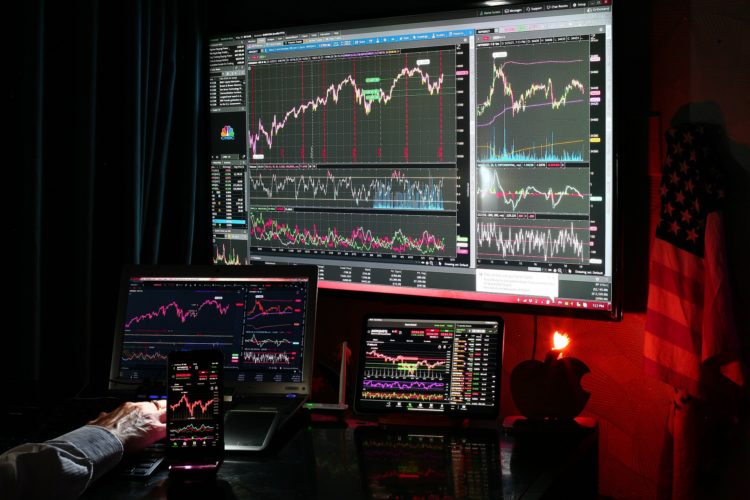
Global markets slumped on Wednesday, November 4, 2026, as investors digested a decisive Democratic victory in the previous day's U.S. midterm elections, with AI-linked shares leading the decline and government bonds emerging as the day's clear winner. The reaction was a textbook case of markets repricing a political regime change — and of how concentrated the AI trade has become.
What happened
According to projections from multiple decision desks, Democrats won control of both the House and the Senate in the November 3, 2026 midterms. The overnight market reaction was sharp: Dow futures fell as much as 408 points (0.79%), S&P 500 futures sank 1.25%, and Nasdaq futures tumbled 2.24% at their worst, before paring losses early Wednesday.
Reuters reported the global picture on Wednesday morning: S&P 500 futures were down 0.6% and Nasdaq futures down more than 2% before cutting losses to about 0.8%, while European futures fell 1.4%. In Asia, the selling concentrated in AI stocks — chipmakers Samsung, SK Hynix, and TSMC slid sharply, and SoftBank led Japan's Nikkei 3% lower to a more than five-month trough. Cryptocurrencies also fell on prospects of stronger regulation.
Bonds moved the other way. The yield on the benchmark 10-year U.S. Treasury note fell 6 basis points to 4.906% as investors sought safety, and the dollar slid broadly — the euro rose 0.5% to $1.1249, sterling firmed 0.37% to $1.3464, and the dollar index fell 0.37% to 101.34.
Why AI stocks took the hit
The AI trade has powered the bull market, and it is unusually exposed to Washington. Investors fear a Democratic Congress could slow the data-center buildout — through permitting scrutiny, energy and environmental review, or direct regulation of AI infrastructure — and could advance stronger tech regulation more broadly. As TD Securities' Newnaha put it, markets were putting "the AI trade on the chopping block" amid the higher possibility that further tax cuts are put on ice and government spending slows.
The context matters: the Nasdaq 100 had already entered correction territory earlier in the week as investors questioned the returns on massive AI investments, and Tuesday's Election Day session itself was mixed — the Dow slipped 0.43% while the S&P 500 rose 0.28% and the Nasdaq gained 0.66% on a semiconductor rebound. Wednesday's selloff therefore extended an existing bout of AI skepticism rather than creating one from nothing.
Why bonds won
Treasuries rallied on a classic gridlock thesis: a divided or opposition-controlled Congress is expected to restrain new spending and block further tax cuts, reducing future Treasury supply and easing upward pressure on yields. At the same time, if AI regulation slows growth, the Federal Reserve may face less pressure to raise rates — the Fed, led by Chair Kevin Warsh, raised its target range to 3.75%–4.00% on September 16, 2026, its first increase since 2023, and held there on October 28. Lower expected growth plus restrained fiscal expansion is a bond-friendly combination, and investors acted on it immediately.
Background: what midterms usually do to markets
Historically, midterm elections resolve uncertainty more than they create it: once results are known, markets typically rally into year-end regardless of which party wins, because legislative gridlock is generally viewed as market-friendly. The 2026 reaction breaks that pattern in one respect — the selloff was concentrated in the market's leadership (AI and semiconductors) rather than broad-based, reflecting how much of the market's recent gains depend on a single theme and a single policy backdrop.
Why it matters for founders and investors
1. Policy risk is now a valuation input for AI infrastructure. Data centers, chipmakers, and AI platforms have traded as if the buildout were a law of nature. The midterm reaction shows that permitting, energy policy, and regulation can reprice the entire theme in a single session. Founders in AI infrastructure should be able to articulate their regulatory exposure — siting, power, water, and supply chain — as crisply as their technology.
2. Bonds are back as a portfolio ballast. After years in which stocks and bonds often fell together, Wednesday's divergence — equities down, Treasuries up — restored the traditional diversification relationship. For founders sitting on raised capital, the yield environment matters directly: the 10-year near 4.9% means cash management and treasury strategy are real sources of return, not an afterthought.
3. Expect a rotation, not just a selloff. Money leaving AI leaders does not necessarily leave equities: value, industrials, and non-AI growth names held up better on Election Day itself, and futures pared losses as the session developed.
4. Crypto regulation risk is real again. The decline in cryptocurrencies on stronger-regulation expectations is a reminder that digital-asset policy remains party-dependent. Crypto founders should plan for a more assertive oversight environment in the next Congress.
What to watch next
The durability of the move is the question. If the selloff reverses within days, it will look like a knee-jerk reaction; if AI names keep lagging while bonds hold their gains, it signals a genuine regime shift in how markets price the AI buildout. The Bank of England decision on Thursday and Friday's payrolls report will test whether the bond rally survives contact with economic data.
Angeled.com connects founders with investors — and in weeks like this, the founders who raise are the ones who can explain how their business performs under either political weather.
Sources: Reuters market report, November 4, 2026 (futures moves, Treasury yield, currency moves, Asian AI-stock declines, SoftBank/Nikkei); Dow Jones/Morningstar European Midday Briefing, November 3, 2026; Saxo Market Quick Take, November 3, 2026 (prior session moves, Fed rate range, calendar of refunding, central bank decisions, and payrolls).
Read Next
The Data-Center Backlash Is Now an Election Issue — and Infrastructure Funding Will Feel It
Alphabet Discloses $548M Qualcomm Stake in Q3 13F Filing — What a 13F Really Shows
Friday's Bounce After the AI Rout: What the Rebound Really Signals
The AI Trade Unwind: What the November 5 Rout Means for Founders
U.S. Stocks Plunge as Nasdaq Enters Correction in AI Trade Unwind
Ad-Tech Splits in Q3: Magnite's Connected TV Surges 39% While Criteo Shrinks 11%