




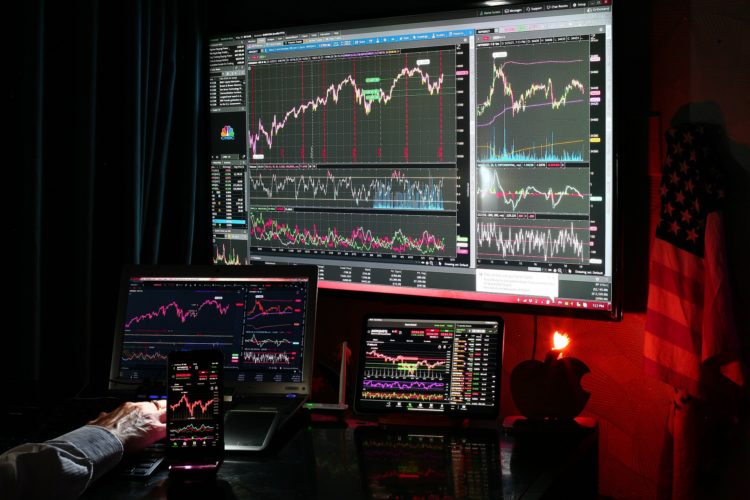
United States stocks closed October 2026 the way they had spent much of the month: with technology leading the way down. On Friday, October 30, the Nasdaq Composite fell 2.86 percent, or 747.73 points, to close at 25,437.00. The S&P 500 lost 1.82 percent to 7,580.07, and the Dow Jones Industrial Average declined 1.09 percent, or 572.25 points, to 51,770.31. The Russell 2000 small-cap index slipped 1.66 percent to 2,811.84.
It was the Nasdaq's worst day since June, and it sealed a difficult month. For October as a whole, the Nasdaq fell about 5.3 percent, its worst monthly performance since March 2025, when markets fell amid tariff concerns. The S&P 500 lost about 1.2 percent for the month, while the Dow finished October higher. That split tells the story: this was a technology rout, not a uniform market collapse.
What drove the selling
The immediate trigger was earnings. Intel plunged 28.58 percent on Friday, its worst single day since 1974, after issuing fourth-quarter revenue guidance of $15 billion to $16 billion, below the $17.07 billion analysts had expected. The company pointed to weak personal computer demand tied to high memory chip prices, alongside manufacturing hurdles and heavy spending to expand production. The fall dragged semiconductor stocks with it: the Nasdaq 100 fell 3.46 percent, and the iShares Semiconductor ETF dropped more than 8 percent.
Alphabet had already set the tone earlier in the week, with a 12.64 percent single-day fall, its largest since its 2004 listing, wiping out nearly $500 billion in market value in one session. Amazon added to the gloom by reporting a record cash outflow as it poured money into data centres. Together, the reports revived the central question of this earnings season: when does enormous spending on artificial intelligence translate into profit, and what happens to valuations if the answer is later than expected?
The Nasdaq Composite is now about 7.8 percent below its record closing high of October 6, 2026. That is a correction in index terms, not a bear market, conventionally defined as a 20 percent fall from a high. But the concentration of damage matters. The Nasdaq 100 was on track for a market-value wipeout of more than $2 trillion for October, according to Reuters reporting cited in market coverage, capturing how much wealth the month's repricing destroyed in the largest technology names.
The Federal Reserve added to the pressure
Monetary policy provided the second headwind. The Federal Reserve held its benchmark rate steady at 3.75 percent to 4.00 percent at its October 27-28 meeting, in a 10-2 vote. Two officials dissented in favour of an immediate rate increase. On Friday, the first comments after the meeting's blackout period pointed in a hawkish direction.
Dallas Fed President Lorie Logan said the Federal Open Market Committee "needs to implement at least two more 25-basis-point rate increases," calling inflation above the 2 percent target unacceptable. She added that after those increases, it would make sense to pause and examine economic developments. St. Louis Fed President Alberto Musalem said additional firming would be necessary "soon," and Richmond Fed President Tom Barkin also argued for further tightening. Futures markets still priced a December rate increase as more likely than holding steady, with the Fed's December 8-9 meeting the next decision point, even as expectations for that hike eased after the October meeting.
Labour cost data released on Friday did not change that picture. The Employment Cost Index rose 0.8 percent in the third quarter, down from 0.9 percent in the second quarter and in line with economists' expectations, according to the Bureau of Labor Statistics. Wages and salaries rose 0.7 percent for the quarter and 3.1 percent over the year. The reading suggested labour costs were unlikely to be a fresh inflation risk, but it was not soft enough to remove the case for tightening.
Background and why it matters
For founders, a falling Nasdaq changes the fundraising climate even for private companies. Public valuations set the reference point for private rounds, and a 5 percent monthly fall in the Nasdaq gives investors reason to negotiate harder and demand more evidence. For investors, October is a reminder that concentration cuts both ways: the same mega-cap stocks that drove the market higher also drove it lower when sentiment turned.
Angeled.com connects founders with investors.
Reuters via InvestorsHub/ADVFN, "Wall Street Slides as Amazon and Intel Earnings Deepen AI Spending Worries," October 30, 2026
Source: qncnews.com
QNC News, "Nasdaq 100 Faces 2 Trillion Dollar October Wipeout," October 31, 2026
Source: marketbriefer.com
Market Briefer, "The Global Close: October 30, 2026," October 30, 2026
Source: kwsn.com
Reuters via KWSN, "Fed officials make case for rate hikes," October 30, 2026
Source: bls.gov
Bureau of Labor Statistics, Employment Cost Index Summary, September 2026
Read Next
The Data-Center Backlash Is Now an Election Issue — and Infrastructure Funding Will Feel It
Alphabet Discloses $548M Qualcomm Stake in Q3 13F Filing — What a 13F Really Shows
Friday's Bounce After the AI Rout: What the Rebound Really Signals
The AI Trade Unwind: What the November 5 Rout Means for Founders
U.S. Stocks Plunge as Nasdaq Enters Correction in AI Trade Unwind
Ad-Tech Splits in Q3: Magnite's Connected TV Surges 39% While Criteo Shrinks 11%