




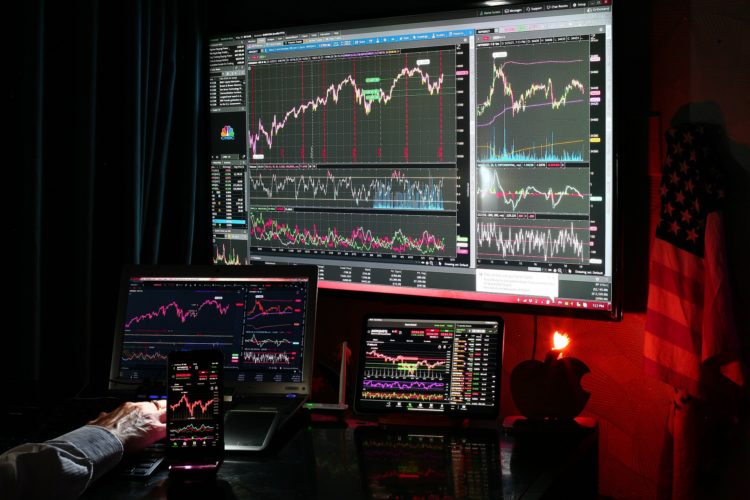
Apple, AMD, and Palantir report earnings this week, arriving after a bruising Friday in which Intel fell nearly 29 percent. The backdrop is a market that spent October repricing its enthusiasm: the Nasdaq fell roughly 7 percent in October, its worst month since April 2025. For founders raising money in November, this week is not background noise. It is a weather report, and the forecast will shape how investors feel about risk, growth, and the price of capital.
Earnings season is often treated as a spectator sport for public-market investors. Founders should treat it as diligence on the whole economy. The companies reporting this week are not just stocks; they are customers, suppliers, acquirers, and benchmarks. What they say about demand, capital spending, and hiring will filter into boardrooms and venture partner meetings within days.
The capex question behind every AI pitch
Hyperscaler capital expenditure is expected to reach roughly $800 billion this year and $1.2 trillion in 2027, according to Goldman Sachs figures cited by Reuters. Those numbers explain both the excitement and the anxiety around artificial intelligence. On one hand, they represent an enormous buildout of computing infrastructure. On the other, they raise a question investors are now asking out loud: who pays, for how long, and when does the spending turn into profit?
That question lands directly on startup pitches. A founder building AI infrastructure, tools, or applications is no longer pitching into a market where spending growth alone is treated as validation. Investors want to know where the revenue comes from, how durable it is, and whether the business survives if the largest spenders slow down. Apple, AMD, and Palantir will each offer a different angle on that question — devices and consumer demand, chips and data-center supply, and enterprise software adoption.
Earnings growth is slowing, and that matters for valuations
S&P 500 earnings-per-share growth is running near 30 percent in 2026 but is expected to slow to about 18 percent in 2027. That is still strong growth by historical standards, but the direction matters. Markets price momentum as much as levels. A slowdown from exceptional to merely strong can still compress the multiples investors are willing to pay, especially for companies whose valuations assumed the exceptional pace would continue.
For private founders, the translation is straightforward: the bar for growth stories rises when public growth slows. A startup growing quickly but burning heavily looks different in a market that is rewarding profitability and discipline than it did when growth alone commanded a premium. Founders who can show a credible path to efficient growth — revenue quality, retention, and unit economics, not just headline growth — will find the current environment more forgiving than those who cannot.
The jobs report is the other half of the story
Two data points frame the week beyond earnings. The ISM manufacturing survey arrives Monday, and payrolls arrive Friday, with a median expectation of about 65,000 jobs added after September's 29,000, and unemployment at 4.2 percent. These are not abstract statistics for founders. Hiring conditions, wage pressure, and consumer demand all flow through the labor market, and the Federal Reserve's next move depends heavily on what it sees there.
Futures markets are currently pricing roughly a 72–73 percent chance of a December Fed rate hike, with about 55 basis points of total tightening priced, down from more than 70 basis points a month ago. The 10-year Treasury yield sits at 4.952 percent. In plain terms, money is expensive and expected to stay expensive, but the market has become slightly less convinced about how much tighter policy will get. A strong jobs report could push expectations back up; a weak one could ease them. Either way, the cost of capital for the next several months will be shaped by Friday's number as much as by any single earnings call.
How founders should read this week
Founders should resist two temptations: ignoring public markets entirely, and overreacting to a single day's move. Private fundraising is not a separate world — investor sentiment, exit expectations, and follow-on capital all move with public markets, even if the timing lags. But one earnings miss or one jobs print does not rewrite a company's prospects.
The useful discipline is simpler: watch what the biggest companies say about demand, watch what the jobs data says about the economy's momentum, and watch what rates say about the price of money. Then ask what those three signals imply for your own next twelve months. If customers are cautious, lengthen your runway assumptions. If hiring is tight, protect your key roles. If capital is expensive, prioritize revenue and efficiency over expansion at any cost.
November's earnings week will not tell any founder whether their company succeeds. But it will tell them what kind of weather they are raising money in — and in fundraising, as in sailing, ignoring the weather is a choice with consequences.
Angeled.com connects founders with investors.
Read Next
The Data-Center Backlash Is Now an Election Issue — and Infrastructure Funding Will Feel It
Alphabet Discloses $548M Qualcomm Stake in Q3 13F Filing — What a 13F Really Shows
Friday's Bounce After the AI Rout: What the Rebound Really Signals
The AI Trade Unwind: What the November 5 Rout Means for Founders
U.S. Stocks Plunge as Nasdaq Enters Correction in AI Trade Unwind
Ad-Tech Splits in Q3: Magnite's Connected TV Surges 39% While Criteo Shrinks 11%